I. Introduction
Black speculative fiction has long existed at the margins of literary production, often relegated to niche publications, small presses, and anthologies that circulated primarily within Black intellectual and artistic communities. Throughout much of the twentieth century, science fiction and fantasy were dominated by white authors such as Isaac Asimov, Aldous Huxley, and Frank Herbert, as well as by Eurocentric worldbuilding traditions. This dominance left little room for narratives centered on Black experiences, histories, or futures, reinforcing the racial exclusions that shaped the genre’s development (Carrington; Lavender).
When Black writers did enter the field, their work was frequently treated as anomalous rather than foundational. Samuel R. Delany, one of the most prominent Black science fiction writers of the late twentieth century, emerged within this constrained literary landscape. A prodigious talent, he won multiple Nebula Awards and a Hugo Award by the age of twenty-seven. Although Delany would later be recognized as a central figure in speculative fiction, his early career reflects the structural limitations placed on Black authors, whose contributions were often overlooked or confined to specialized readerships (Delany; Carrington).
This marginalization extended beyond publishing into the realm of imagination itself. The absence of Black voices in mainstream science fiction signaled a broader cultural exclusion in which Black existence was frequently positioned outside of futurity. In response, Black speculative fiction developed as both a literary practice and a political intervention, reasserting Black presence in imagined futures while interrogating the historical conditions that produced that exclusion. As Kodwo Eshun argues, Black speculative practices “recover the histories of counter-futures created in a century hostile to Afrodiasporic projection” (301).
Over the past several decades, Black speculative fiction has undergone a profound transformation. What was once a peripheral and often inaccessible tradition has become a central force in contemporary culture, influencing literature, film, television, and global popular discourse. Tomi Adeyemi’s Children of Blood and Bone trilogy exemplifies this transition. The series achieved bestseller status and attracted major film adaptation efforts, reflecting the increasing visibility and cultural capital of Black speculative storytelling (Adeyemi).
Despite these transformations in visibility, scale, and market reception, the thematic core of Black speculative fiction remains remarkably consistent. Across generations, Black writers have used speculative frameworks to explore politics, identity formation, systemic oppression, cultural memory, and resistance. These recurring concerns demonstrate that Black speculative worlds do more than provide aesthetic escape; they actively engage historical and social realities through reimagined lenses (Thomas xvii; Lavender).
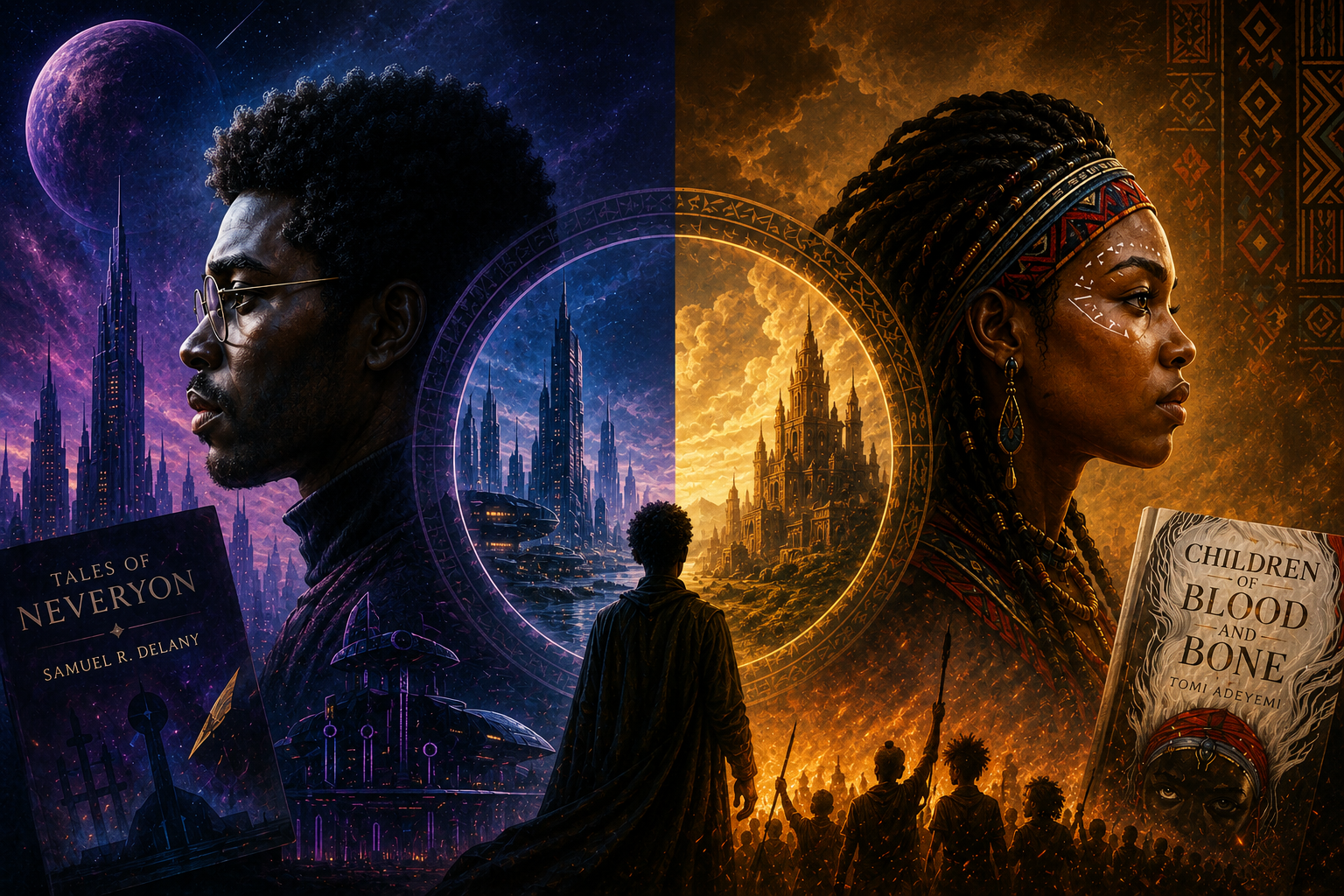
This paper argues that while Black speculative fiction has evolved from a marginalized literary form into a mainstream cultural phenomenon, its core thematic and narrative concerns demonstrate a striking continuity across time. Through a comparative analysis of Samuel R. Delany’s Tales of Neveryon and Tomi Adeyemi’s Children of Blood and Bone trilogy, this study examines how Black authors separated by nearly six decades engage similar questions of power, identity, and resistance while employing distinct narrative strategies shaped by their historical and cultural contexts. By placing these texts in dialogue, this paper demonstrates that Black speculative fiction is both historically continuous and formally adaptive.
II. The Rise of Black Speculative Fiction
Black authors writing within science fiction and fantasy faced significant structural barriers, including limited access to mainstream publishing platforms and a lack of institutional recognition. André M. Carrington notes that Black authors were often excluded from “the institutional networks that legitimated science fiction as a genre” (Carrington). The rise of Afrofuturism as both a cultural movement and an academic framework further contributed to the visibility of Black speculative fiction. Coined by Mark Dery and expanded by scholars such as Alondra Nelson and Kodwo Eshun, Afrofuturism provided a language for understanding how Black artists engage with technology, futurity, and speculative imagination. Dery defined Afrofuturism as “speculative fiction that treats African American themes and addresses African American concerns in the context of twentieth-century techno culture” (Dery 180). This definition introduced a key paradox: how could a people historically excluded from narratives of progress imagine themselves within the future?
Simultaneously, changes within the publishing industry created new opportunities for Black authors, as publishers increasingly recognized the commercial potential of stories that appealed to broader and more diverse readerships. As a result, Black speculative fiction began to move from the margins toward the center of the literary marketplace. N.K. Jemisin has noted that the industry’s push for “diversity” was often market-driven rather than purely ideological, as publishers recognized the commercial potential of stories that appealed to a broader and more diverse readership. As a result, Black speculative fiction began to move from the margins toward the center of the literary marketplace. Samuel R. Delany’s early career illustrates both the possibilities and limitations of this period. As one of the few Black authors to achieve recognition within mainstream science fiction during the 1960s and 1970s, Delany occupied a complex position. On one hand, his work gained critical acclaim and helped to expand the boundaries of speculative fiction through its experimental style and thematic depth. On the other hand, his presence within the field was frequently treated as exceptional rather than indicative of a broader movement. The relative absence of Black voices in earlier science fiction was not due to a lack of creativity but to systemic exclusions embedded within the genre’s production and reception (Lavender).
The turn of the century marked a crucial turning point in the consolidation of Black speculative fiction as a recognizable tradition. Sheree R. Thomas’s collection of essays, Dark Matter: A Century of Speculative Fiction of the African Diaspora, (2000) demonstrated the historical continuity of Black speculative writing. As Thomas writes, the collection reveals “a living tradition…not a new phenomenon but one long overlooked” (Thomas, xvii). By situating contemporary authors alongside earlier figures, Thomas demonstrated the historical continuity of Black speculative writing and challenged the notion that it was a recent or marginal phenomenon. Afrofuturism is not an anomaly but a rich and continuous tradition, carried over from ancestral roots. Later critical works, including Isiah Lavender III’s Black and Brown Planets (2014) and Eugene Bacon’s Afro-Centered Futurisms in Our Speculative Fiction (2025), further established the field as a legitimate area of scholarly inquiry, foregrounding the ways race, power, and identity shape narratives. further established the field as a legitimate area of scholarly inquiry, foregrounding the ways race, power, and identity shape narratives. This act of canon formation was further reinforced by subsequent volumes and critical studies, which collectively established Black speculative fiction as a legitimate and significant field of literary inquiry.
N.K. Jemisin, the first writer to win three consecutive Hugo Awards for Best Novel, and Tomi Adeyemi, whose debut novel became an international bestseller, exemplify this transformation. Their success reflects not only individual achievement but also a broader shift in the cultural status of Black speculative storytelling. These works are no longer confined to niche audiences but are widely read, taught, and adapted across media platforms.
Despite these advances, it is important to recognize that the rise of Black speculative fiction does not represent a complete break from its earlier history but rather an expansion and amplification of existing traditions. The increased visibility of Black speculative fiction thus reflects both continuity and change: continuity in its thematic concerns and cultural significance, and change in its modes of production, distribution, and reception. Understanding this historical trajectory is essential for contextualizing the works of Delany and Adeyemi. While separated by decades and operating within vastly different literary landscapes, both authors participate in a shared tradition of Black speculative storytelling. Their works illustrate how the genre has evolved in form and visibility while maintaining a consistent commitment to reimagining Black existence within speculative frameworks.
III. Cultural Tropes and Themes of Black Speculative Fiction
Black speculative fiction, while diverse in form and style, is unified by a set of recurring themes and narrative tropes that reflect both historical realities and imaginative reconfigurations of Black existence. These elements function as critical tools through which authors interrogate systems of identity and belonging. Black speculative narratives consistently engage questions of race, culture, and agency, often reworking traditional science fiction and fantasy structures to center Black history and cosmologies. Understanding these recurring patterns is essential for analyzing how Black sci-fi/fantasy authors such as operate within—and transform—this literary tradition.
One of the most pervasive themes is systemic oppression. For example, N.K. Jemisin’s The Fifth Season constructs a world in which oppression is literally geological and institutionalized, while Octavia Butler’s Kindred collapses time to reveal the persistence of slavery’s violence across history (Jemison; Butler). These narratives often mirror historical and contemporary realities of racialized violence, colonialism, and social stratification. In doing so, they transform these worlds into allegorical spaces where mechanisms of power can be exposed and understood. This structural focus allows Black speculative fiction to function simultaneously as narrative and sociopolitical critique.
Another central theme is identity formation, which often unfolds in direct relation to systems of oppression. Protagonists often undergo journeys that are both physical and psychological, negotiating identities shaped by both personal agency and structural constraint. These journeys often involve recovering or redefining identities that have been suppressed or distorted. The “chosen one” trope, common in fantasy literature, is reinterpreted within Black speculative fiction as a burden tied to ancestry, cultural memory, or responsibility rather than individual destiny alone. In Adeyemi’s Children of Blood and Bone, for instance, magical ability is inseparable from lineage and trauma, while in Delany’s work, identity is fluid and shaped by linguistic and social structures. In both cases, self-discovery is inseparable from an awareness of power and marginalization.
Another central theme is diaspora, memory, and the reclamation of history. Black speculative fiction frequently engages the legacy of the African diaspora, exploring how displacement, migration, and fragmentation have the power to shape identity across time and space. These narratives collapse linear time, bringing past, present, and future into dialogue. This reconstructive engagement with the past seeks to recover histories that have been rewritten or erased and to reimagine their implications for the future.
The interplay between spirituality and power also emerges as a defining feature. Eugene Bacon notes that Afro-centered speculative fiction frequently positions spirituality as a key site of resistance and meaning-making (Bacon 12). In contrast to many Western speculative traditions that privilege technological advancement or secular worldbuilding, Black speculative narratives often integrate spiritual systems and cosmologies rooted in African and diasporic traditions. These systems function as alternative epistemologies, challenging dominant frameworks of knowledge and authority. Eugene Bacon notes that Afro-centered speculative fiction frequently positions spirituality as a key site of resistance and meaning-making (Bacon 12). In Adeyemi’s work, magic is explicitly tied to divine forces and ancestral lineage, while even in Delany’s more secular narratives, systems of meaning and belief remain central to the organization of power and identity.
A further key theme is resistance and revolution, which often serves as the narrative engine of Black speculative fiction. Given the emphasis on systemic oppression, many of these narratives center on acts of rebellion, whether collective or individual. Resistance may take the form of organized revolution, personal defiance, or the reclamation of suppressed identities and histories. Importantly, Black speculative fiction often complicates traditional heroic narratives by foregrounding the ethical ambiguities and costs of resistance. Rather than presenting revolution as a simple triumph, these works explore its internal tensions and consequences, reflecting a broader understanding of resistance as an ongoing and multifaceted process.
In addition to these thematic concerns, Black speculative fiction is characterized by several recurring narrative tropes and formal strategies. One such trope is the reimagining of the hero’s journey, in which individual destiny is deeply intertwined with collective struggle. Unlike classical Western models that emphasize individualism, Black speculative protagonists are often embedded within networks of community, ancestry, and shared history. Another common feature is the construction of hybrid worlds, where elements of fantasy, science fiction, and historical narrative coexist. This blending of genres reflects a broader resistance to rigid categorical boundaries, allowing authors to construct more expansive imaginative spaces.
Equally significant is the role of language and storytelling as sites of power. In Delany’s work in particular, language is not a neutral medium but an active force that shapes reality, identity, and social hierarchy. This emphasis reflects a broader concern within Black speculative fiction with who has the authority to tell stories and whose narratives are legitimized. As Kodwo Eshun suggests, Afrofuturist and Black speculative practices often involve reconfiguring narrative structures as a means of challenging dominant cultural logics (Eshun 300). Through experimentation with form, voice, and structure, Black speculative writers create new possibilities for representation and meaning.
Finally, Black speculative fiction is deeply invested in the concept of reclaiming the future. The historical exclusion of Black people from dominant visions of the future necessitates a deliberate reimagining of what the future can look like. As Mark Dery famously questioned, how can a community whose past has been systematically erased imagine its future (Dery 180). Black speculative fiction responds to this challenge by asserting the presence of Black bodies, cultures, and identities within speculative futures, positioning them as central rather than peripheral. This act of reclamation is both imaginative and political, reshaping not only narrative possibilities but also cultural expectations.
Taken together, these themes and tropes reveal Black speculative fiction as a dynamic literary tradition that engages deeply with questions of power and possibility. While individual authors emphasize different elements or employ distinct narrative strategies, these recurring concerns provide a critical framework for understanding how the genre operates across time and context. This framework will serve as the basis for the comparative analysis of Samuel R. Delany’s Tales of Neveryon and Tomi Adeyemi’s Children of Blood and Bone trilogy in the sections that follow.
IV. Delany’s Tales of Neveryon: Fragmentation, Language, and the Unstable World
Samuel R. Delany’s Tales of Neveryon resists easy categorization. Neither wholly fantasy nor strictly science fiction, the text exists in a liminal space, a narrative terrain as shifting and unstable as the desert landscapes through which its characters move. Composed of four interconnected novellas—“The Tale of Gorgik,” “The Tale of Old Venn,” “The Tale of Small Sarg,” and “The Tale of Potters and Dragons”—the work refuses linear progression, instead offering a fragmented, recursive meditation on power, language, and the construction of social systems. To read Neveryon is to enter a world where meaning itself is constantly deferred, rewritten, and contested.
At the center of this narrative constellation is Gorgik the Liberator, a figure who at first glance appears to embody the archetypal heroic liberator: a former slave who becomes a revolutionary force against systems of bondage. Yet Delany destabilizes this trope almost immediately. Gorgik is not a singular, coherent identity but a figure constructed through constantly shifting perspectives. He is at once a man, a symbol, and a story told differently depending on who speaks his name. In this sense, Gorgik is the embodiment of liberation, revealing the extent to which power itself is mediated through narrative.
Delany’s treatment of slavery and economic systems is particularly striking. Unlike more conventional speculative narratives that position oppression as a moral aberration to be overcome, Neveryon situates slavery within a complex web of economic exchange and cultural norms. Chains in Neveryon are not only physical restraints but signs—objects that carry meaning, value, and social significance. To remove the chain is not necessarily to dismantle the system that gives it power. As Delany suggests, systems of oppression persist not simply through force but through the ways they are named and reproduced in language. This aligns with Lavender’s assertion that speculative fiction can expose the structural nature of race and power, rather than reducing them to individual acts of prejudice (Lavender).
Language, in Neveryon, is never neutral. It is unstable, slippery, and often inadequate. Words fail, meanings fracture, and communication becomes an uncertain act. Delany foregrounds this instability through his narrative structure, which frequently interrupts itself with metafictional commentary, shifting perspectives, and contradictory accounts. Stories begin, dissolve, and reconstitute themselves in altered forms. In this way, Tales of Neveryon becomes a meditation on the limits of representation: how can systems as vast and entrenched as slavery, hierarchy, and power ever be fully captured in language? At times, the text feels almost self-conscious of its own insufficiency, as if it recognizes that every attempt to tell the story is already a distortion. And yet, it is precisely through this fragmentation that Delany opens space for alternative meanings. By refusing coherence, he resists the imposition of a singular, authoritative narrative. Instead, Tales of Neveryon invites the reader to inhabit uncertainty by navigating a world in which truth is always partial and contingent.
Each novella contributes to this larger project in distinct ways. “The Tale of Gorgik” introduces the figure of the liberator while simultaneously complicating his role, presenting liberation as an ongoing, unstable process. “The Tale of Old Venn” shifts the focus to storytelling itself, exploring how narratives are constructed, transmitted, and transformed over time. Here, the act of telling becomes as significant as the events being told, emphasizing the role of the storyteller in shaping reality. “The Tale of Small Sarg” further destabilizes narrative authority by centering a character whose perspective is limited, fragmented, and often uncertain. Through Sarg, Delany explores how individuals navigate systems they cannot fully comprehend, highlighting the gap between lived experience and structural understanding. Finally, “The Tale of Potters and Dragons” expands the scope of the narrative, weaving together multiple threads while refusing to resolve them into a cohesive whole. Dragons, often symbols of power or mythic order in traditional fantasy, appear here as elusive and ambiguous, their meaning never fully fixed.
Across these novellas, Delany engages in what might be described as a deconstruction of fantasy itself. Traditional fantasy relies on coherent worldbuilding, stable systems of meaning, and clearly defined moral arcs. Tales of Neveryon, by contrast, dismantles these conventions, exposing the constructed nature of all narrative systems. This approach aligns with broader Afrofuturist practices that seek to challenge dominant epistemologies (Eshun 312).
At the same time, Neveryon is deeply concerned with the body—particularly the Black body—as a site of inscription and control. Bodies in the text are marked, categorized, and regulated, yet they also resist these inscriptions in subtle and unexpected ways. Identity is never fixed but constantly negotiated, shaped by interactions between language, power, and desire. Delany’s inclusion of queer sexuality further complicates traditional notions of Black identity, positioning fluidity as the defining condition of subjectivity.
There is, also, a persistent tension between structure and dissolution. Systems of power seek to stabilize meaning, to define and control, while the narrative itself continually unravels those efforts. The result is a text that feels both constructed and in the process of being undone. Reading it is like trying to map a shifting landscape: every attempt at clarity reveals new layers of complexity, new fractures in the terrain. And yet, within this instability, there is a form of possibility. By refusing to present a singular, authoritative vision of the world, Delany creates space for multiple interpretations, multiple futures. If traditional speculative fiction often seeks to build worlds, Neveryon seeks to show how worlds are built—and how they might be rebuilt differently.
Delany’s formal experimentation can also be understood in relation to the intellectual and political climate of the 1960s through the 1980s, particularly the Civil Rights Movement and its aftermath, when questions of language, power, and representation became central to Black cultural production (Carrington; Lavender). Writing during a period in which structural racism was being publicly challenged yet remained deeply embedded in American institutions, his focus on unstable systems reflects broader critical concerns with authority and the politics of meaning (Delany; Eshun). His marginal position within a predominantly white science fiction industry further shaped his refusal to conform to conventional genre expectations, as Black writers were often treated as exceptions rather than foundational contributors (Carrington; Lavender). In this sense, the fragmentation of Tales of Neveryon mirrors both the exclusions of the literary marketplace and the era’s skepticism toward singular, authoritative narratives (Delany; Eshun).
In this sense, Delany’s work can be understood as both a product of its historical moment and a radical reimagining of speculative form. Writing within a period in which Black speculative fiction remained marginalized, Delany does not simply insert Black characters into existing genre frameworks but fundamentally reshapes those frameworks. His work challenges readers to reconsider not only what speculative fiction can depict but how it can think.
V. Adeyemi’s Children of Blood and Bone Saga: Myth, Memory, and the Reclamation of Power
Where Samuel R. Delany’s Tales of Neveryon fractures narrative and destabilizes meaning, Tomi Adeyemi’s Children of Blood and Bone trilogy moves in the opposite direction: it gathers, consolidates, and amplifies. Drawing on West African mythology and themes of racial oppression, the series combines elements of epic fantasy with contemporary social critique. Adeyemi constructs a world that is urgent and propulsive. Her narrative is driven by momentum, emotion, and the weight of inherited history. Yet beneath its sweeping plot and accessible structure lies a thematic core deeply aligned with the traditions of Black speculative fiction: an insistence on confronting systemic oppression, reclaiming stolen identity, and imagining Blackness in defiance of historical erasure.
Adeyemi’s trilogy emerges from a twenty-first-century context shaped by the increasing visibility of Black voices in popular culture and renewed public attention to systemic racial violence, making its political themes especially resonant for contemporary readers (Adeyemi; Thomas). Unlike Delany, who wrote during a period when Black speculative fiction remained largely marginalized, Adeyemi works in a publishing environment more open to diversity, even as it remains influenced by commercial imperatives (Carrington; Thomas). Her direct treatment of oppression, surveillance, and inherited trauma reflects a contemporary moment in which Black writers are more able to address racial injustice explicitly within mainstream genre fiction (Adeyemi; Bacon). At the same time, her use of West African mythology aligns with a broader cultural investment in reclaiming African and diasporic histories long excluded from dominant fantasy traditions (Bacon; Thomas).
Set in the fictional land of Orïsha, the trilogy centers on a society in which magic—once an integral part of cultural and spiritual life—has been violently suppressed by a ruling monarchy. The maji, identifiable by their white hair and latent magical abilities, are subjected to persecution, surveillance, and state-sanctioned violence. This foundational conflict is an unmistakable allegory for racialized oppression, continuing the writing of the lived experiences of Delaney’s generation. Adeyemi’s world does not obscure its political stakes; it foregrounds them, translating the realities of anti-Black violence into a fantastical framework that is both accessible and emotionally resonant. At the heart of the narrative is Zélie Adebola, a protagonist who embodies the reimagined hero’s journey central to Black speculative fiction. Like Gorgik, Zélie is marked by her relationship to systems of oppression, but where Delany disperses identity across language and narrative, Adeyemi anchors it in emotion, lineage, and embodied experience. Zélie’s power reflects ancestral inheritance, tied to her mother, her community, and a broader cultural memory that the state seeks to erase. Magic, in this context, becomes both a literal and symbolic force.
Adeyemi’s treatment of oppression is direct and unambiguous. The monarchy’s campaign against the maji is organized, institutional, and sustained, reflecting what Eugene Bacon describes as the centrality of power structures in Afro-centered speculative fiction (Bacon 12). Public executions, discriminatory laws, and constant surveillance create a climate of fear that shapes every aspect of life in Orïsha. Unlike Delany’s more abstract and linguistically mediated systems, Adeyemi’s depiction of oppression is visceral and immediate, designed to evoke emotional recognition and moral urgency in the reader. The violence is not hidden within metaphor. It is visible, named, and confronted. Yet the trilogy is not solely defined by suffering. It is equally invested in the reclamation of identity and cultural memory. Zélie’s journey is one of remembering as much as it is one of becoming. The restoration of magic marks a return to a previous state; an act of cultural recovery, that reasserts lost histories and identities that have been forcibly suppressed. In this way, Adeyemi’s work aligns with the broader tradition identified in Dark Matter, in which Black speculative narratives draw on diasporic memory to construct alternative futures (Thomas xiii). The past in Children of Blood and Bone is active, shaping the present and enabling the possibility of transformation.
Spirituality plays a central role in this process. Unlike many Western fantasy traditions that separate magic from religion, Adeyemi integrates the two, grounding her magical system in a pantheon of deities and a cosmology inspired by Yoruba belief systems. The gods are not distant figures are active participants in the narrative whose presence reinforces the connection between power and the divine. This integration of spirituality functions as an alternative epistemology, challenging secular frameworks of knowledge and authority. Such spiritual systems offer modes of understanding that resist colonial and Eurocentric paradigms (Bacon 5).
The narrative’s momentum is driven by resistance and revolution, which operate at both personal and collective levels. Zélie’s quest to restore magic evolves into a broader fight against the structures that enforce inequality, drawing together a coalition of characters with differing motivations and perspectives. Importantly, Adeyemi does not present resistance as simple or unified. Conflicts emerge within the group, alliances shift, and moral boundaries blur. Characters such as Amari and Inan complicate the narrative by embodying the tensions between complicity and resistance, privilege and empathy. Inan serves as a counterpoint to Zélie, illustrating how individuals shaped by oppressive systems may both perpetuate and struggle against them. This complexity extends to Adeyemi’s engagement with the hero’s journey as a collective rather than individual process. While Zélie remains the central figure, the narrative consistently emphasizes interdependence, community, and shared struggle. Victory is never the result of a single hero’s actions but of collective effort, sacrifice, and negotiation. This reconfiguration of the hero’s journey reflects a broader shift within Black speculative fiction, in which individualism is tempered by an awareness of communal responsibility.
Formally, Adeyemi’s storytelling contrasts sharply with Delany’s experimental approach. The trilogy employs a linear, multi-perspective narrative structure, allowing readers to move fluidly between characters while maintaining a clear sense of progression. This accessibility is a deliberate strategy, enabling the text to reach a wider audience and to engage readers who may not be familiar with more experimental forms of speculative fiction. There is, in Adeyemi’s prose, a sense of urgency that propels the narrative forward and also latches onto the reader. Scenes unfold with cinematic intensity, emotions are heightened, and stakes are consistently reinforced. Where Tales of Neveryon invites the reader to linger in ambiguity, Adeyemi demands movement, action, and response. The world of Orïsha does not drift—it burns, it fractures, it calls for change. And yet, even within this momentum, moments of reflection and vulnerability emerge, grounding the narrative in the lived experiences of its characters.
Ultimately, Adeyemi’s trilogy represents a reconstruction of myth. Drawing on the thematic foundations of Black speculative fiction—oppression, identity, memory, and resistance—she reshapes them into a narrative that is expansive, accessible, and deeply resonant with contemporary audiences. If Delany’s work deconstructs the mechanisms of storytelling, exposing their instability, Adeyemi’s work rebuilds them, offering a vision of what Black speculative fiction can become in a moment of increased visibility and cultural recognition.
VI. Continuities Across Time: Similarities Between Delaney And Adeyemi
Despite the temporal, stylistic, and structural differences that separate Samuel R. Delany’s Tales of Neveryon and Tomi Adeyemi’s Children of Blood and Bone trilogy, both works operate within a shared conceptual framework that defines Black speculative fiction as a mode of cultural, political, and imaginative intervention. Across six decades, these texts return to the same central concerns—systems of oppression, the construction of identity, the role of memory and history, and the necessity of resistance—suggesting not a coincidence of theme but the persistence of a literary tradition grounded in the ongoing realities of Black existence. What changes between Delany and Adeyemi is not the what of their storytelling, but the how.
At the most fundamental level, both authors construct worlds in which oppression is systemic rather than incidental. In Tales of Neveryon, slavery is embedded within economic and linguistic systems, sustained through the meanings assigned to bodies, objects, and social roles. Chains symbolize not just physical restraint but participation in a broader system of value and exchange. Similarly, in Children of Blood and Bone, the persecution of the maji is institutionalized through law, surveillance, and state violence. The monarchy’s authority depends on the systematic erasure and control of a marginalized group, transforming oppression into an organizing principle of society. In both cases, power is not located in individual antagonists alone but in the structures that shape everyday life.
Flowing from this shared emphasis on systemic power is a parallel investment in identity as a site of struggle and construction. Both authors present identity as a negotiation within—and often constrained by—systems of domination. Gorgik, the so-called liberator of Neveryon, exists as a figure whose identity is constantly mediated through narrative; he is defined as much by the stories told about him as by his actions. His selfhood is unstable, dispersed across perspectives and interpretations. Zélie, by contrast, experiences identity as embodied and inherited, rooted in her connection to magic, ancestry, and cultural memory. Yet despite these differences in representation, both characters are shaped by forces beyond their control, navigating identities that are imposed, resisted, and redefined over time. In both texts, to know oneself is also to understand the systems that attempt to define and limit that self.
A further point of convergence lies in the centrality of history, memory, and the reclamation of the past. Black speculative fiction frequently refuses the separation of past and future, instead presenting them as interconnected temporalities. In Neveryon, this connection is often indirect, emerging through fragmented narratives and the layering of stories that echo and contradict one another. The past is never fully accessible, only partially reconstructed through unreliable accounts. In Adeyemi’s trilogy, the relationship to the past is more explicit: the loss of magic represents a rupture in cultural continuity, and its restoration becomes an act of historical recovery. Zélie’s journey is, in many ways, a process of remembering—of reclaiming a lineage that has been systematically suppressed. As Sheree R. Thomas suggests, Black speculative narratives often draw on diasporic memory to imagine alternative futures, positioning the past as both a source of trauma and a foundation for possibility (Thomas xiii). Both Delany and Adeyemi participate in this process, though through different narrative strategies.
Closely tied to memory is the presence of resistance as both action and condition. In neither Neveryon nor Children of Blood and Bone is resistance presented as a singular, triumphant event. Instead, it is ongoing, complicated, and often incomplete. Gorgik’s efforts to dismantle systems of slavery are marked by ambiguity; liberation is never absolute, and the structures he seeks to undo persist in altered forms. Similarly, Zélie’s quest to restore magic evolves into a broader fight against entrenched systems of power, one that involves sacrifice, internal conflict, and moral uncertainty. Both texts resist the simplicity of conventional heroic narratives, emphasizing that resistance is not a moment of resolution but a continuous process of negotiation and struggle.
Another significant point of continuity is the emphasis on the body as a site of power, control, and meaning. In Neveryon, bodies are marked, categorized, and exchanged within systems of value, their significance determined by social and economic structures. The physical presence of the chain becomes a visible inscription of power relations. In Adeyemi’s work, the bodies of the maji are similarly marked—visibly identifiable by their silver locks and therefore subject to surveillance and violence. This visibility renders them vulnerable, transforming the body into both a target and a symbol. Across both texts, the body is not merely a vessel for character but a contested space where systems of domination are enacted and resisted.
Taken together, these similarities reveal that Black speculative fiction operates as a continuous and evolving tradition rather than a series of isolated works. Delany and Adeyemi, though separated by time and shaped by different literary and cultural contexts, engage in a shared project. Their differences in style and form reflect shifts in audience, industry, and historical moment, but their thematic alignment underscores the enduring concerns that define the genre. In this sense, the relationship between Neveryon and Children of Blood and Bone reveals a thematic continuity, as well as an enduring literary conversation about racial oppression and resistance.. They are part of the same conversation, speaking across decades in different registers, yet asking the same fundamental questions: Who has power? Who is seen? Who is remembered? And who gets to imagine the future?
VII. Conclusion: Imagining Resistance and Writing Black Futures
The evolution of Black speculative fiction from the mid-twentieth century to the present reveals a genre that has expanded in visibility and influence while maintaining a remarkable continuity in its thematic concerns. Black speculative narratives persistently return to questions of power, identity, memory, and resistance. These works demonstrate that speculative fiction continuously holds a space for imaginative escape and a critical site for interrogating the structures that shape lived experience and for envisioning alternative possibilities.
Delany’s fragmented, linguistically complex narratives expose the instability of systems that present themselves as natural or inevitable, revealing how power operates through language, economy, and perception. Adeyemi’s expansive and emotionally driven storytelling, by contrast, reclaims myth and narrative clarity to foreground the urgency of resistance and the necessity of cultural restoration. Together, these works illustrate the adaptability of Black speculative fiction: a tradition capable of both deconstructing dominant frameworks and reconstructing new ones that center Black existence.
It is within this ongoing tradition that my own creative and scholarly work is situated. My graduate thesis, Imagining Resistance: Writing Black Liberation through Sci-Fi and Fantasy, seeks to extend the lineage traced in this paper by engaging directly with the possibilities of speculative storytelling as a mode of cultural reclamation. Like the works of Delany and Adeyemi, my project is concerned with the relationship between power and narrative—specifically, how stories can be used to recover, reassemble, and reimagine Black histories that have been fragmented or erased.
At its core, my creative work aims to construct a speculative world that traverses both historical and contemporary Black communities, bridging temporal and geographic divides between African and African American experiences. This movement across time and space is a stylistic choice, yes, but also a deliberate engagement with the concept of diaspora, reflecting the ways in which Black identities are shaped by displacement, connection, and continuity. By drawing on both African and African American cultural traditions, my project seeks to resist the fragmentation imposed by colonialism and slavery; instead emphasizing interconnectedness and shared heritage.
Central to this effort is the recovery of what might be described as “lost” or suppressed narratives—stories, cultural practices, and histories that have been marginalized within dominant historical frameworks. My work approaches the past as a dynamic and generative force; one that can be reimagined and reactivated through speculative means. Science fiction and fantasy, in this context, become tools for excavation as much as invention, allowing for the reconstruction of histories that official records have failed to preserve.
At the same time, Imagining Resistance engages directly with the theme of liberation as an ongoing process rather than a fixed endpoint. Drawing inspiration from Delany’s emphasis on the instability of systems and Adeyemi’s focus on collective resistance, the narrative will explore how liberation is negotiated, contested, and continually redefined. Rather than presenting freedom as a singular achievement, the project seeks to depict it as a condition that must be maintained, challenged, and reimagined across generations.
Ultimately, Imagining Resistance is an attempt to participate in what can be understood as a larger cultural project: the reclamation of the Black future. By centering Black voices, histories, and perspectives within speculative frameworks, the work seeks to challenge the limitations that have historically constrained representations of Black life and to imagine new possibilities for what those representations can become.
The works of Delany and Adeyemi demonstrate that Black speculative fiction is not defined by a single style or approach but by its commitment to reimagining the conditions of Black existence. Whether through fragmentation or cohesion, ambiguity or clarity, these narratives create spaces in which the past can be revisited, the present interrogated, and the future reclaimed. My own work enters this space with the same imperative: to imagine resistance, to write liberation, and to ensure that the stories once silenced are not only remembered but brought vividly and unapologetically into the foreground.
Works Cited
· Adeyemi, Tomi. Children of Blood and Bone. Henry Holt and Company, 2018.
· Bacon, Eugen, editor. Afro-Centered Futurisms in Our Speculative Fiction. Bloomsbury Academic, 2024.
· Butler, Octavia E. Kindred. Beacon Press, 2004.
· Carrington, André M. Speculative Blackness: The Future of Race in Science Fiction. University of Minnesota Press, 2016.
· Delany, Samuel R. Tales of Neveryon. Wesleyan University Press, 1993.
· Dery, Mark. “Black to the Future: Interviews with Samuel R. Delany, Greg Tate, and Tricia Rose.” Flame Wars: The Discourse of Cyberculture, edited by Mark Dery, Duke University Press, 1994, pp. 179–222.
· Eshun, Kodwo. “Further Considerations on Afrofuturism.” CR: The New Centennial Review, vol. 3, no. 2, 2003, pp. 287–302.
· Jemisin, N. K. The Fifth Season. Orbit, 2015.
· Lavender, Isiah, III, editor. Black and Brown Planets: The Politics of Race in Science Fiction. University Press of Mississippi, 2014.
· Thomas, Sheree R., editor. Dark Matter: A Century of Speculative Fiction from the African Diaspora. Warner Books, 2000.
