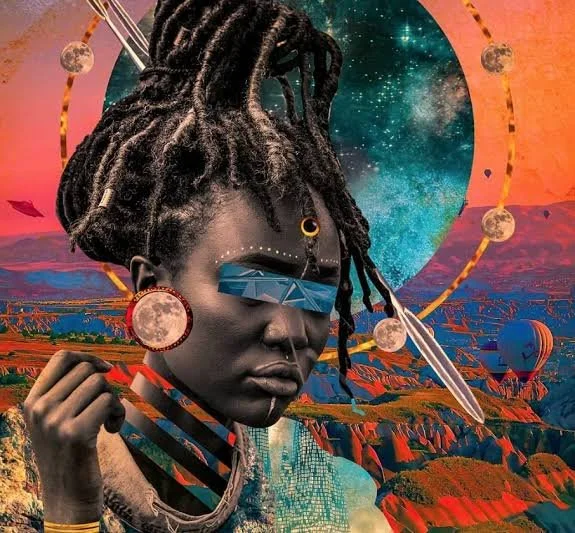
Before it was a term, it was a practice. Before anyone named it, Black souls were already thinking and dreaming beyond the world that tried to contain them. “Afrofuturism”, also referred to as “Afrocentric Futurism”, is a word I have come across, almost accidentally, in my quest to learn the fundamentals of speculative fiction—the “sci-fi special sauce,” if you will. Since childhood, I have found great comfort in the imaginary; the fantastical. Books became my obsession. As often as they could, my eyes devoured stories of dragon riders and potion makers and mad scientists and mystical warriors—all of whom were the heroes and arbiters of their own futures. The more I read, however, the more frustrated I became: none of these tales were made for me, or for young kids like me. The heroines—either slim with ‘olive skin’ or slender with wefts of golden tresses—did not represent me with my wide face and wide hips, my dark hair and even darker skin. And so now, as a young adult (teetering on the edge of that ‘young’), I have decided to write the stories I never had. I find it necessary, especially as a black woman living in an increasingly “American” context, to use my art to bring forth the Blackest stories, inspired by Black life and histories, written for the advancement of all Black peoples.
Unsurprisingly, this journey has led me right back to books—only this time, I find myself drawn to works like, Africa Risen: A New Era of Speculative Fiction (edited by Sheree Renee Thomas), Black and Brown Planets: The Politics of Race in Science Fiction (edited by Isaiah Lavender III), and Afro-Centered Futurisms in Our Speculative Fiction (edited by Eugene Bacon). In an effort to ‘check my own bias,’ I even studied Speculative Whiteness: Science Fiction and the ALT-Right. In every text I uncovered, in some way or form, Afrofuturism was referenced. So what is it? Some scholars say it is a “decentering of the imperial gaze, and a recentering of afrodescendants” or a “mode of critical thinking” or even a “rejection of science vs cosmology.” [Okungbowa, 7] For me, it is all of these things but also predates these things. Contrary to most scholastic thought, Afrofuturism did not begin in 1994 when Mark Dery coined the term to describe “African-American themes in technoculture.” [Dery, Black to the Future] It began much earlier—in coded spirituals that imagined deliverance, in Sun Ra’s cosmic declarations that he came from Saturn, in Octavia Butler’s quiet but seismic insistence that Black women could literally shape galaxies. It began wherever Black people required imagination to ensure their survival.
To define Afrofuturism, then, is not simply to categorize a genre. It is to trace a lineage of resistance through abstract thought and behaviors. It is to recognize that for people historically denied a stable past and promised no future, futurity itself becomes radical. The formal naming of Afrofuturism in the 1990s gave academic language to something artists had been doing for decades. Dery’s framing positioned Black speculative production within conversations about technology and science fiction. [Dery, 184] But even his formulation carried a paradox: how could a community whose histories were violently interrupted see themselves in a genre obsessed with progress and the future? That paradox is the point. Eugene Bacon sums it up nicely in his essay “An Afrofuturistic Dystopia and the Afro-irreal.” He states, simply:
Afrofutursim is a projection of what blackness means today and what blackness might mean in the future.
Afrofuturism emerges from rupture. The transatlantic slave trade was not just geographic displacement; it was a temporal one, as well. Black people were severed from ancestral timelines and thrust into a modernity that rendered them property. Afrofuturism answers that rupture by reclaiming time itself. Kodwo Eshun writes of “recovering the histories of counter-futures,” suggesting that Black culture has always been negotiating time differently—out of sync with dominant narratives of Western progress. [Eshun, 298] Afrofuturism becomes a recalibration. It bends linear time into something cyclical, spiritual, ancestral. It asks: What if the future is not something we are excluded from, but something we author? Bacon expands this lineage by insisting on plurality—futurisms, not futurism. This distinction matters. Afrofuturism has often been read through a diasporic, particularly African American, lens. Bacon’s anthology reminds us that speculative Black futures are not singular; they are continental, multilingual, hybrid. [Bacon, 56-57] They are rooted in folklore as much as in technology. They are as concerned with spirit as with science. In this way, Afro-centered futurisms shift the axis. They do not ask how Blackness fits into science fiction. They ask how science fiction must expand to accommodate Black cosmologies.
The cultural impact of Afrofuturism is inseparable from visibility. For generations, mainstream science fiction imagined futures where Black people were absent, erased, or reduced to metaphor. [Carrol, 11] Afrofuturism interrupts that absence. It inserts Black bodies into spaceships. It crowns Black women as architects of new worlds. It imagines African cities as technological epicenters rather than sites of lack. When Black Panther rendered Wakanda as an uncolonized technological superpower, Black peoples let out a collective exhale—a welcome relief to the single story of African history. Black Panther was revolutionary because it visualized abundance without apology. It offered a counter-image to centuries of deficit narratives.
But the cultural work runs deeper than representation. Afrofuturism reorients power; it challenges the assumption that Western science is the only legitimate pathway to the future. Afro-centered futurisms have the ability to blend ancestral knowledge, ecological balance, oral tradition, and speculative technology. [Okungbowa, 9-10] They resist the binary between primitive and advanced—a binary that has long underwritten colonial ideology. For Black audiences, this matters profoundly. Science fiction becomes not escapism but reclamation. Yet Afrofuturism is frequently misunderstood. It is often aestheticized—reduced to metallic fabrics, neon braids, or cosmic backdrops. While visual iconography plays a role, Afrofuturism is not merely style. It is epistemology. It asks challenging questions around whose knowledge counts, and why. It asks whose future is presumed or protected.
A common misperception is that Afrofuturism is exclusively technological. [Lavender, 23] This reading flattens its complexity. Afro-centered futurisms frequently center spirituality, myth, and cosmology. In many African practices, technology and spirit are not opposites; they coexist. The Western separation between rational science and sacred belief does not hold in the same way. [Onoh, 64-66] There is also tension around ownership. Who gets to define Afrofuturism? Is it diasporic? Continental? Global? Nnedi Okorafor distinguishes “Africanfuturism” from Afrofuturism to mark a geography-centered practice untethered from Western mediation. In her words, Africanfuturism “is concerned with the visions of the future…and predominantly written by people of African descent (black people) and is rooted first and foremost, in Africa.” Africanfuturism can then be classified as a response to Afrofuturism—a collaborative act that brings the ‘African voice’ of black authors with a lived experience of Africa. These subtle, semantic distinctions reveal both richness and friction around the use and critique of the term.
With visibility comes commodification. As Afrofuturism gains mainstream traction, it risks dilution. Corporate branding can absorb its aesthetic without engaging its politics. Afrofuturism, especially in today’s appropriation society, can quickly become a marketing mood board rather than a radical framework. There is also the challenge of expectation. Once Black speculative work is labeled Afrofuturist, it may be pressured to perform futurity in specific ways. This can limit quieter, earthbound, or experimental Black speculative forms that do not fit recognizable Afrofuturist imagery. Additionally, Afrofuturism must continually navigate the weight of history. Speculating about Black futures often requires reckoning with persistent sociopolitical inequities. Utopian visions can feel naive in the face of ongoing violence. Dystopian narratives, meanwhile, risk normalizing Black suffering. The tension lies here: how to imagine beyond trauma without erasing it.
It is increasingly undeniable the ways in which Afro-centered futurisms are moving toward multiplicity. Writers and artists are expanding beyond outer space and cybernetic images into climate fiction, bio-engineering, spiritual futurism, and post-apocalyptic, human narratives rooted in African ontologies. There is immense attention to language reclamation, indigenous practices, and non-Western frameworks of science. The future of Afrofuturism is less about folding into existing science fiction canons and more about restructuring the canon itself. It is also becoming increasingly transnational. Black speculative dialogue now flows between Lagos, London, Kingston, Johannesburg, Atlanta, and beyond. Digital platforms accelerate this exchange, allowing diasporic communities to imagine collectively. Most importantly, Afro-centered futurisms are foregrounding interiority. Not only grand futures, but intimate ones. Not only world-building, but self-making. The liminal, in-between stories.
Afrofuturism is not simply about what tomorrow looks like. It is about who survives to see it. It is about who is allowed to dream it. Historically born from rupture, culturally sustained through resistance, and continually evolving across geographies, Afrofuturism remains a living practice. It refuses erasure. It refuses singularity. It insists that Black life is not an afterthought in the narrative of progress. To engage Afrofuturism in relation to science fiction for Black audiences is to recognize speculative fiction as more than genre. It is rehearsal space. It is archive. It is prophecy. And above all, it is the reclamation of time and history. The future is not something Black communities are waiting to enter. It is something they have already begun to build.
Works Cited
1. Sheree Renée Thomas, et al. Africa Risen. Tordotcom, 2022.
2. Bacon, Eugen. Afro-Centered Futurisms in Our Speculative Fiction. Bloomsbury Publishing USA, 2024.
3. Lavender, I. (2014) Black and brown planets : the politics of race in science fiction. University Press Of Mississippi.
4. Chan, Diana. “Sun Ra biography and career timeline” 30 Jan. 2026, www.pbs.org/wnet/americanmasters/sun-ra-biography-and-career-timeline/37462/. Accessed 11 Mar. 2026.
5. Eshun, Kodwo. “Further Considerations of Afrofuturism.” Cr: The New Centennial Review, 2003.
6. Carroll, J.S. (2024) Speculative Whiteness. U of Minnesota Press.
7. Dery, Mark. Flame Wars : The Discourse by Cyberculture. Duke University Press, 1994, p. 180.
