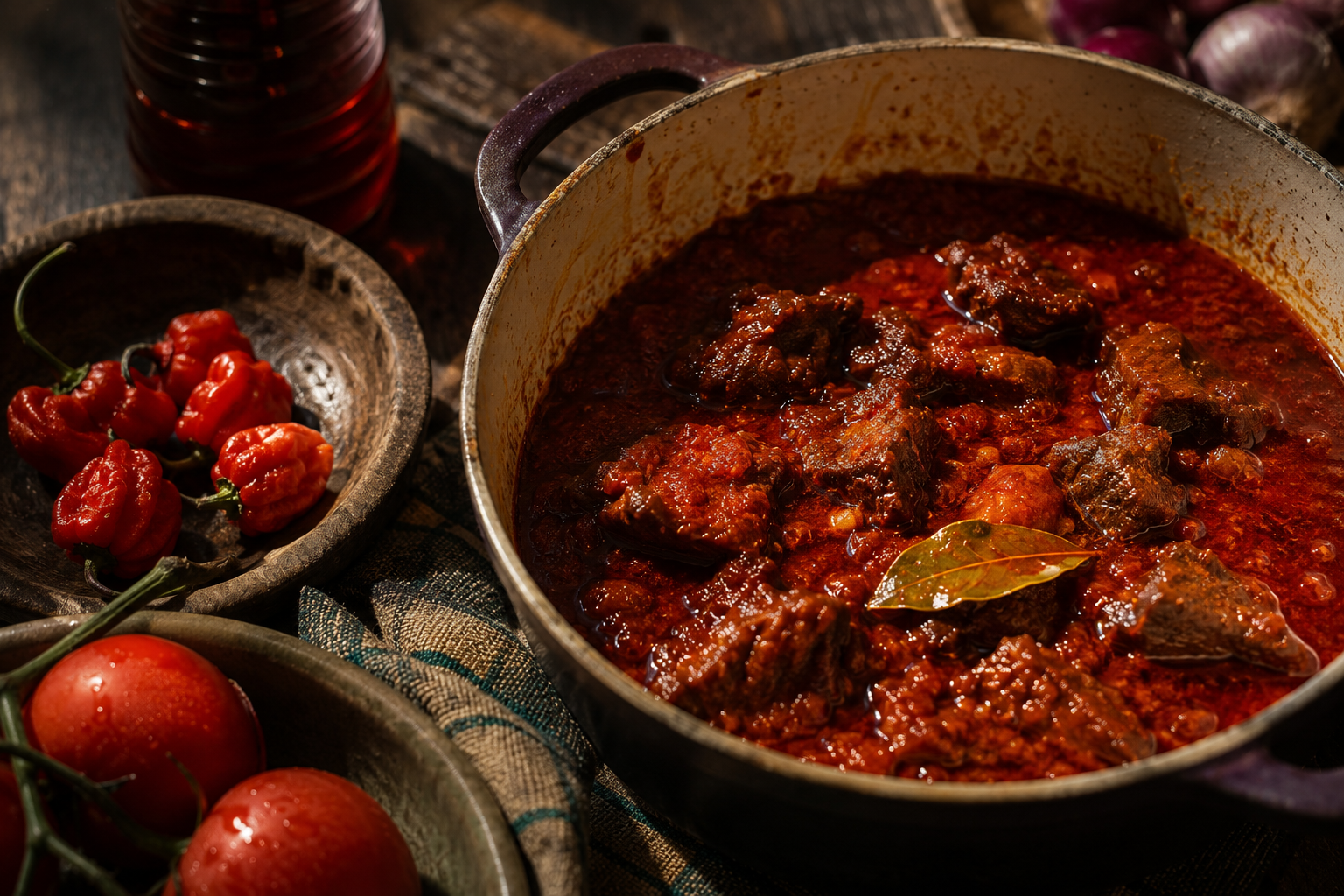
I. Tomatoes
My mother says the tomatoes must be very red, red like shame, red like joy, red like the wrappers her own mother wore in Owerri market. She says this over FaceTime, her voice breaking into pixels while I stand in a too small American kitchen holding three pales of refrigerated tomatoes that taste like nothing.
“Blend it smooth,” she instructs. “Not wet. Smooth.”
I never saw my grandmother cook. I only know her hands from one photograph. Square palms with thick black fingers, ripe as plantain. In the photo she is bent over a basin of tomatoes, her thumbs pressing each one as if testing for a pulse. My mother tells me she could tell a good tomato by scent alone.
When I blend mine, the machine screams and the puree flies for freedom, splashing my shirt. I taste it from there—bright, metallic, almost sweet. I imagine the market my mother described. I see flies circling mounds of produce. The heat lifting the smell of fruit and diesel into a single breath. I have never been there. My homesickness is for a place I know only in anecdotes, in the way my mother elongates certain vowels when she speaks of “home.”
The tomatoes collapse into liquid. I watch them whirl and think this is what inheritance looks like. Whole things turned to pulp so they can travel farther.
II. Pepper
The first time I made the stew alone, I did not understand the pepper.
“Just one scotch bonnet,” my aunt texted from Lagos. “Maybe two. Don’t be afraid.”
I was indeed afraid. Not of the heat, but of the high potential to err. For a while, I left it sat there on the countertop and the pepper stared back at me like a dare. How much of me do you trust yourself to withstand?
In the blender it glowed orange, a small sun dissolving into the red. When I fried the mixture, the air grew thick, sharp and accusatory. My eyes watered and I coughed so hard I had to open all the windows in my panic room of a kitchen. The smoke alarm blinked like it knew I was pretending at something.
My mother laughs when I tell her this story. “Pepper teaches you,” she says.
She tells me how, as a girl newly arrived in London, she once made stew for her flatmates and forgot the pepper entirely. They praised it. Said it was delicious. She cried afterward in the bathroom, ashamed of their approval. And of her own slow, absentminded colonization.
“The stew must fight back,” she tells me. “Otherwise, it is not ours.”
I add another pepper on the second attempt. The burn sits on my tongue long after I swallow, a reminder that belonging is not always gentle. Sometimes it announces itself as a pain you choose.
III. Palm Oil
Palm oil stains everything.
It arrives in a reused plastic bottle mailed from a cousin who insists the American versions are too pale, too thin, too shy to hold any real flavor. I smile at the foreign label, wondering what the original content tasted of. When I pour it into the pot, it spreads like lacquer, thick and sunset bright. The kitchen smells suddenly older—like something with a memory.
My father rarely talks about Nigeria, but he talks about palm oil. About how, when he was a boy, his mother would store it in clay pots that kept it cool even in the harmattan heat. He tells me this as if describing a myth.
“When it’s hot enough,” he says, “you’ll know. The oil will shimmer.”
I wait for the shimmer. I watch the surface tremble. The oil coats the wooden spoon, slick and defiant. It splatters my wrist, leaving a tiny welt that I watch, transfixed, darken into a brown crescent.
Palm oil is not subtle. It does not blend into the background. It insists on color, on presence. When I bring stew to potlucks, the oil separates slightly at the top, a red halo that makes people wary.
“What is that?” they ask.
“Flavor,” I say.
“Does it stain?”
“Palm oil always stains.”
But what I mean is: this is the part of me that will not dilute. This is proof that I come from somewhere saturated. Somewhere specific. Even if I only know it through other people’s stories.
IV. Beef
My grandmother believed in bones. My mother tells me this while I trim fat from supermarket-packaged cubes labeled stew meat.
“Bones give it body,” she says. “The marrow thickens the sauce.”
I search for beef with marrow and find only sanitized cuts, drained of the story of their blood. Still, I brown them carefully, letting each side darken before turning. The meat sizzles, releases its scent—iron and smoke. As it cooks, I can hear my mother recounting how her own mother would wake before dawn on Sundays to prepare stew for the week. The house would fill with the smell of frying beef, neighbors drifting in with bowls and gossip.
“I used to complain,” she admits. “I wanted cereal like the English children.”
Now she calls me from a kitchen three thousand miles away to supervise my browning technique. “Don’t rush it,” she warns. “Let it sear. Let it become.”
The beef tightens, then relaxes in the sauce. I think of my mother as a girl who wanted something plainer, and of myself as a woman trying to reclaim what she once resisted. We were circling the same pot from different times, a mirrored reflection of the other’s desires. My mother and her wistful longing for a new culture. And me, reaching for connection to an old one.
When I finally taste the stew, the meat yields softly. It has absorbed the tomatoes, the pepper, the oil. A mixing pot of flavor and culture and story. Maybe this is what the bones were for—anchoring. Giving the broth (blood) a structure to cling to.
V. Simmer
The stew must never be hurried. Once everything is in the pot—tomatoes reduced, pepper tamed, oil shining, beef surrendered—you lower the flame and wait.
My mother says this is when the flavors fight and then forgive each other.
I sit at the small table in my apartment and listen to the gentle burble. The surface shifts lazily, small eruptions that release pockets of scent: sweet, sharp, smoky. The sound is almost like breathing. I imagine my grandmother’s kitchen again, though I have never stood in it. I borrow details from my mother’s stories: a radio playing highlife, a window stuck half-open, the rhythm of a knife against a wooden board. In my mind, the stew simmers there too, decades ago, the same red gloss.
When I finally spoon it over rice and take a bite, I taste patience layered between the spices. It does not transport me to Nigeria—I have no sensory memory to return to. Instead, it builds a bridge made of repetition. Each time I cook it, the story grows thicker. Homesickness, I realize, can be forward-facing. It can be a longing not only for what was lost, but for what you are still learning to make.
The pot is empty, only for now. A thin ring of oil still stains to the sides. Tomorrow, I will call my mother and tell her how it turned out. She will ask what I changed, and I will say, “A little more pepper this time.” And somewhere between her instructions and my improvisation, the stew will continue—an inheritance worth simmering, unfinished, alive.
