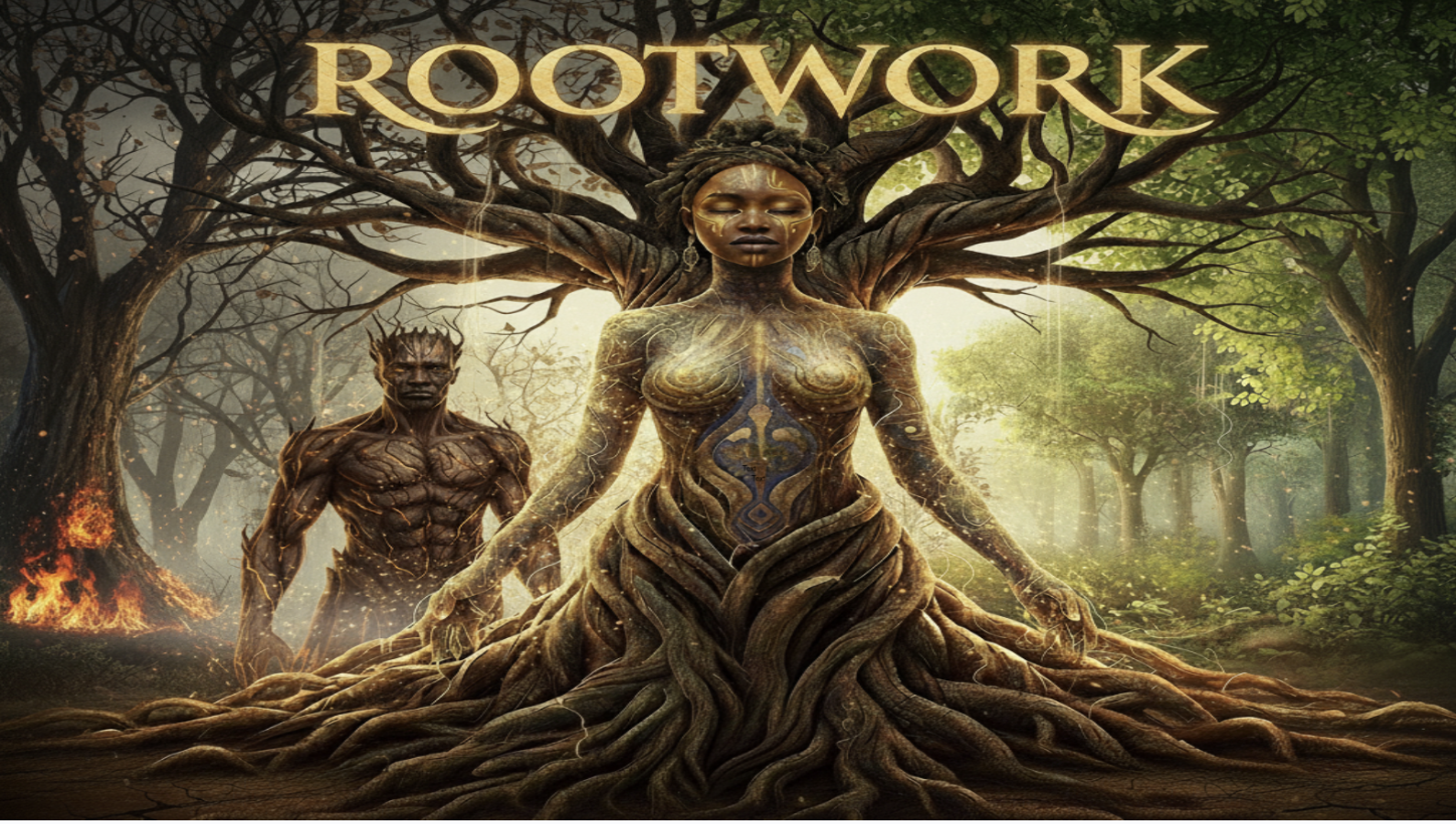
Feature Film - Treatment Draft
Logline: after a lost soul awakens in a rotting forest Deep in the groves of Southern georgia with no memory of her death, she crosses paths with an ancient tree spirit that promises her answers to the questions that torment her.
As the two journey across time and land, their shared history unravels as they embark on a dangerous and spiritual reckoning––where death, mercy, and justice all take root in the same soil
Synopsis: Abeni awakens angry and afraid, believing herself the victim of senseless cruelty. her fragmented memories are steeped in fear and confusion as she retraces her steps towards the source of her tension. When Oba––an ancient and afflicted tree spirit––finally reveals himself to her, his confessions unravel her. abeni learns that her death was both a violent act and a merciful one, a paradox born of desperation and compassion. This revelation forces her to confront not only the truth of her own death but also the vast, unhealed suffering embedded in the land itself. As her understanding deepens, Abeni surrenders to the power of the forest, fusing her spirit with its roots, becoming both its memory and its weapon. In the end, the land begins to heal, but the healing is not gentle—it demands remembrance and accountability rather than forgiveness.
Narrative Story Arc:
Beginning: “Decay”
Abeni awakens beneath the tree that hanged her, surrounded by fog and rot. Her memories come in flashes: dogs barking, the sound of chains, the smell of iron. The forest whispers her name, but she recoils from the trees—each creak of bark sounds like a scream. She believes the forest murdered her in cold blood.
Middle: “Revelation”
Oba, the tree spirit, reveals himself—his form humanoid but cracked, his veins pulsing with sap and sorrow. He tells Abeni that he took her life not in hatred but to spare her from capture, knowing what awaited her in the world of men. His “mercy” was still a killing, and for that he has rotted ever since.
As Abeni and Oba journey through the forest, they encounter echoes of the enslaved who died there. Each spirit clings to its pain, feeding the land’s decay. Abeni’s presence stirs something within them—branches begin to bloom black flowers; sap runs red.
The forest begins to collapse under the weight of its unhealed wounds. Abeni realizes she cannot escape her death—she must become part of the forest’s memory to heal it.
Ending: “Rebirth” or “Rootwork”
Abeni and Oba perform a ritual at the tree where she died. She places her hand upon his bark, merging her spirit with his roots. From their union grows a strange fruit—dark, luminous, pulsing with ancestral magic.
This new life is not pure; it is vengeful, meant to poison those who desecrate the land and to protect those who remember. The forest begins to bloom again—half decay, half resurrection.
In the final image, travelers passing through the woods hear whispers and see a shadowed woman’s figure moving between trees. The forest is alive, and it remembers.
Characters:

Abeni (The Human Spirit):
Once a runaway BRIDE, Abeni is disoriented, paranoid, distrustful, and quick towards fight over flight. Abeni is a wounded woman until she realized that love will be her salvation. Her arc is one of reclaiming truth: moving from confusion and rage toward a sacred understanding of mercy, and finally wielding her death as a form of creation. She reconciles with her past and vows to use her spiritual knowledge for both retribution and remedy.

Oba (The Tree Spirit):
An ancient spirit of the land, worn and wise. He is rooted in guilt; his body bears scars of countless deaths. In ending Abeni’s suffering, he sought to free her from worse torment, but now her restless ghost–along with the unchecked killing of thousands of other souls–haunts him. He speaks in slow, mournful tones—his words like the groan of bending wood. Through Abeni, he finds redemption and purpose: to weaponize remembrance.
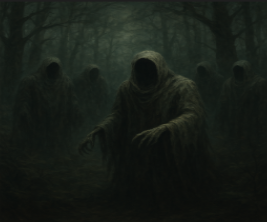
The Akudaaya (Lost Souls):
The souls of the dead; trapped between life and death because they cannot find peace. They shroud their faces because they cannot remember who they were in life, so they are faceless in death. They only speak telekinetically
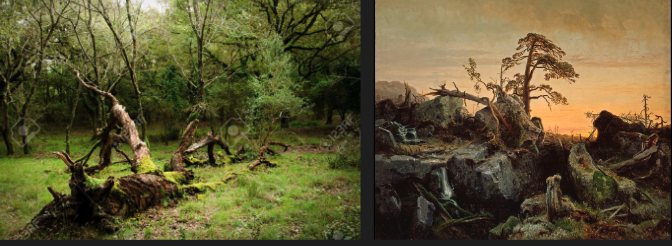
The Forest: More than a setting—it is a breathing, decaying soul. The leaves rot, the air festers, and yet flowers bloom from corpses. The forest remembers every injustice done on its soil.
Style: The art style of “Rootwork” will mimic the tone of black southern gothic films, blending nodes of spiritual surrealism and hoodoo. The goal would be to create a world that feels haunting and rotted–– but also lush, and deeply powerful. lots of slow pans and close up shots, maybe lingering on textures (sweat on skin, bark, fog) and letting each image resonate on screen.
Visually, imagine an array of deep greens, reds, and browns. picture moonlight slicing through shadows to reveal moments of revelation, danger, or tension. The spiritual transformations of the characters will come through in the colors (using symbolism and color theory) of each scene, rather than a big dramatic spectacle.
Technically, the film will adopt the use of vfx for the visualization of oba (treelike vfx) and for any explosions or energy transfers
Key Themes: At its core, Rootwork explores the entanglement of mercy, violence, and memory within a living landscape. It asks whether killing can ever be an act of compassion, blurring the line between cruelty and mercy in the face of unbearable suffering. The film treats the land itself as a living witness to Black pain—its decay and regrowth mirroring the cycles of trauma and remembrance. Through the concept of rootwork, ancestral pain becomes a source of strength and protection, suggesting that what once destroyed can also heal. Nature, in this world, is not passive scenery but a witness—trees, soil, and roots hold the truths that human history seeks to bury, ensuring that nothing truly forgotten ever stays dead.
References:
Beloved (1998): Ghostly exploration of memory, motherhood, and historical haunting. Like how trauma and the supernatural can reflect in the overall tone.
Eve’s Bayou (1997): Lyrical Southern Gothic storytelling steeped in Black mysticism, family secrets, and emotional intimacy.
Black Panther (2018): Specifically the ancestral plane sequences. Love the ending scene and line “Bury me in the ocean with my ancestors that jumped from the ships, because they knew death was better than bondage.”
The Tree of Life (2011): Like the fluid use of nature to represent cosmic and spiritual connection. Good visual reference
